Why Many SEO Agencies Fail at Tailoring Strategies for Businesses (And How to Fix It)
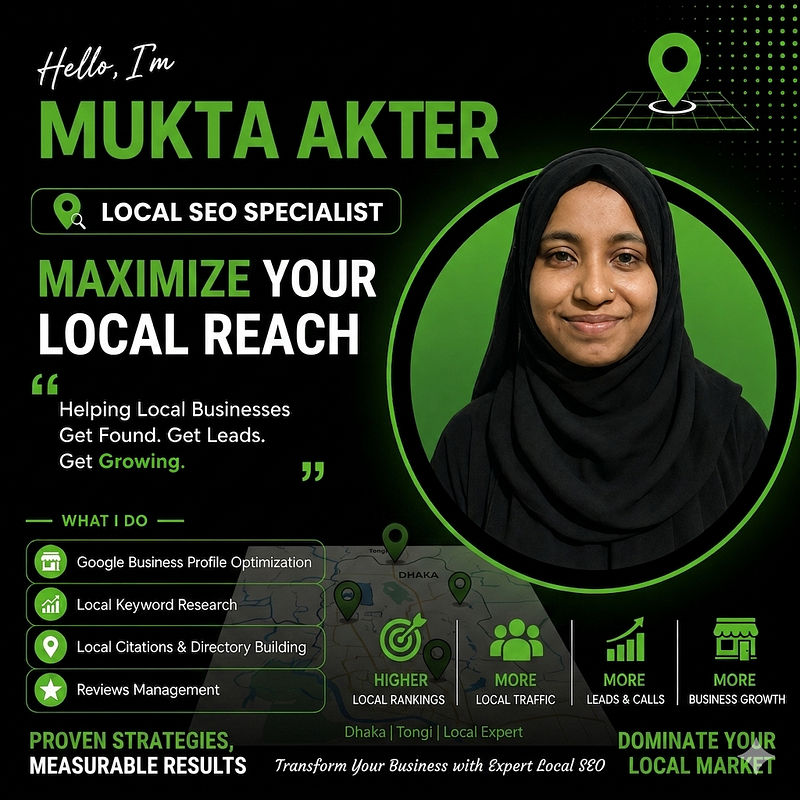
Discover why most SEO agencies fail at customization, how cookie-cutter strategies hurt local businesses, and what truly tailored SEO looks like in 2026. Expert insights by Mukta Akter, Local SEO Specialist
Why Many SEO Agencies Fail at Tailoring Businesses (And How to Fix It)
Introduction: The Hidden Problem in the SEO Industry
Most businesses investing in SEO expect one thing: growth that reflects their unique market, customers, and goals. Yet, a large number of companies end up with generic strategies that look polished on reports but fail to deliver real-world results.
This gap is not accidental it comes from a systemic issue in the SEO industry: lack of true business-specific customization.
In today’s AI-driven search landscape, Google no longer rewards surface-level optimization. It rewards context, relevance, experience, and entity-based authority signals.
That’s where many agencies fall short.
As Mukta Akter, I’ve seen this pattern repeatedly across local businesses in the USA and Canada SEO campaigns that technically “look correct” but are strategically disconnected from the business reality.
Let’s break down why this happens and how to fix it.
1. The Template Problem: One Strategy Fits All
Many SEO agencies operate on standardized workflows:
- Keyword research template
- Generic on-page SEO checklist
- Pre-built backlink packages
- Recycled content frameworks
While efficient, this approach ignores a critical truth:
Every business has a different search intent ecosystem.
For example:
- A local plumber in Toronto depends heavily on emergency-based queries.
- A boutique law firm in New York depends on authority + trust-driven informational searches.
- A restaurant in Chicago depends on map visibility and review signals.
Yet many agencies apply the same SEO blueprint to all.
Why this fails
Because Google’s ranking systems now prioritize:
- Topical authority
- Local relevance
- Behavioral signals
- Entity relationships
A template cannot capture those nuances.
2. Weak Business Understanding Before SEO Execution
One of the biggest failure points is skipping deep business discovery.
Agencies often fail to understand:
- Profit margins per service
- Customer lifetime value
- Seasonal demand patterns
- Competitor positioning
- Conversion bottlenecks
Without this, SEO becomes “traffic chasing” instead of revenue engineering.
A proper SEO strategy should begin with business intelligence not keywords.
3. Ignoring Local SEO Reality (A Major Miss for Small Businesses)
Local SEO is not just about rankings it’s about real-world visibility in geographic intent searches.
Common mistakes include:
- Poor Google Business Profile optimization
- Ignoring local citations consistency
- Weak review acquisition strategy
- No location-based content architecture
In markets like the USA and Canada, “near me” searches have extremely high conversion intent. Yet many agencies still treat local SEO as a secondary layer instead of the core strategy.
This is where expert practitioners like Mukta Akter focus differently building strategies around local intent clusters, not just keywords.
4. Over-Reliance on Tools Instead of Strategy
SEO tools are powerful but they don’t understand context.
Agencies often rely heavily on:
- Keyword volume tools
- Automated audit reports
- AI-generated content suggestions
But tools cannot interpret:
- Brand positioning
- Customer psychology
- Market saturation differences
- Competitive intent gaps
This leads to technically optimized content that lacks emotional and commercial relevance.
5. Content Without Entity Optimization (Modern SEO Killer)
Modern SEO is shifting from keywords to entities and context networks.
Google now understands:
- Brands
- Services
- Locations
- People
- Topics and relationships
If your content doesn’t clearly define these relationships, it loses ranking potential.
Example:
Instead of just “SEO services in USA,” strong SEO includes:
- Business type context
- Local relevance
- Industry-specific challenges
- Trust signals
Without this, content becomes interchangeable and loses authority.
6. Lack of Conversion-Focused SEO Strategy
Ranking is not the end goal. Revenue is.
Many agencies optimize for:
- Traffic
- Impressions
- Keyword rankings
But ignore:
- Lead quality
- Conversion pathways
- Landing page psychology
- Call-to-action optimization
This creates a dangerous illusion of success: “traffic is growing,” but business revenue remains flat.
7. No Adaptation to AI Search Evolution
Search is no longer just Google SERPs.
Now we have:
- Google AI Overview
- ChatGPT answers
- Perplexity summaries
- Bing Copilot insights
These systems prioritize:
- Clear structured answers
- Authority signals
- Entity-rich content
- Direct, extractable information
Agencies that fail to adapt to this shift are already falling behind.
8. What High-Performance SEO Actually Looks Like
A modern, effective SEO strategy includes:
✔ Business-first SEO mapping
Understanding revenue drivers before keywords.
✔ Local intent clustering
Grouping search behavior by geography + intent.
✔ Entity-based content architecture
Building topical authority networks.
✔ Conversion-focused optimization
Designing SEO for sales, not just traffic.
✔ AI-search readiness
Structuring content for AI extraction and summarization.
This is not optional anymore it is the new baseline.
Future Trends in SEO Tailoring (2026 and Beyond)
- AI-generated search answers will reduce click-through rates
- Entity-based ranking signals will grow stronger
- Hyper-local personalization will dominate local SEO
- Brand authority will outweigh keyword density
- “Generic SEO” agencies will lose market share rapidly
Businesses that survive will be those that invest in deeply tailored SEO ecosystems, not templates.
FAQ
Why do SEO agencies use the same strategy for all clients?
Because it is scalable and easier to manage, but it sacrifices performance and personalization.
What is tailored SEO?
Tailored SEO is a customized strategy built around a business’s industry, location, customers, and revenue goals.
Why is local SEO important for small businesses?
It drives high-intent traffic from nearby customers who are ready to purchase or convert.
What is the biggest SEO mistake agencies make?
Focusing on rankings instead of business outcomes like leads and revenue.
How is AI changing SEO?
AI systems now prioritize structured, entity-rich, and context-aware content over keyword-heavy pages.
Conclusion: The Future Belongs to Tailored SEO
The SEO industry is undergoing a major transformation. Generic strategies are no longer enough to compete in AI-driven search environments.
Businesses need strategies that are built around:
- Real customer behavior
- Local market dynamics
- Entity-based search understanding
- Conversion-focused architecture
Professionals like Mukta Akter emphasize one core principle:
SEO is not about ranking pages. It’s about building search ecosystems that reflect real business reality.
Agencies that fail to adapt will continue producing reports.
Agencies that evolve will produce results.
Comments
Post a Comment