How to Get Your First 100 Customers: A Proven Growth Strategy for Local Businesses in the USA & Canada
How to Get Your First 100 Customers: A Proven Growth Strategy for Local Businesses in the USA & Canada
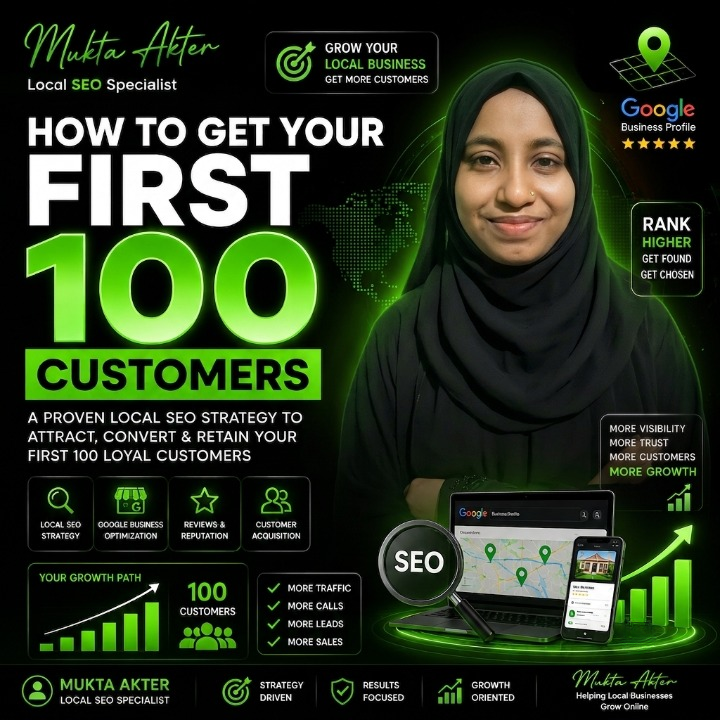
Learn how to get your first 100 customers using proven Local SEO, AI-powered marketing, referrals, Google Business Profile optimization, and trust-building strategies. Expert insights by Mukta Akter, Local SEO Specialist.
How to Get Your First 100 Customers: The Complete Growth Blueprint for Local Businesses
Getting Your First 100 Customers Isn’t Luck It’s Strategy
Every successful business starts with one customer.
Then ten.
Then one hundred.
The biggest challenge for most local businesses isn’t creating a great product or service it’s getting discovered.
Today’s customers search online before making almost every purchasing decision. Whether they need a dentist, plumber, attorney, restaurant, salon, or marketing agency, Google has become the new front door of every business.
That means visibility equals revenue.
As Mukta Akter, Local SEO Specialist, I have seen one consistent truth: businesses that invest in online visibility early build stronger, more sustainable growth than businesses relying only on referrals or paid advertising.
The first 100 customers create momentum.
Once you build trust, reviews, and local authority, customer acquisition becomes significantly easier.
This guide explains exactly how.
Why Your First 100 Customers Matter
The first 100 customers help your business build:
- Online credibility
2. Customer testimonials
3. Google reviews
4. Word-of-mouth referrals
5. Local authority
6. Repeat customers
7. Predictable revenue
Instead of chasing every new lead, you begin creating a system that continuously attracts customers.
Step 1: Understand Your Ideal Customer
Many businesses try to market to everyone.
Successful businesses market to someone specific.
Ask yourself:
- Who needs your service?
2. What problem are they trying to solve?
3. What questions do they ask Google?
4. What motivates them to buy?
For example:
Instead of targeting “restaurants,” target:
- Family-owned restaurants
2. Italian restaurants
3. New restaurant openings
4. Restaurants with poor Google visibility
Specific messaging always converts better than generic marketing.
Step 2: Build a Google-First Presence
For local businesses, Google is often the highest-converting marketing channel.
Your digital foundation should include:
Google Business Profile
Optimize:
- Business category
2. Services
3. Products
4. Business description
5. Photos
6. FAQs
7. Opening hours
8. Service areas
A fully optimized Google Business Profile increases your chances of appearing in:
- Local Pack
2. Google Maps
3. Google AI Overview
4. Voice Search
Create a Professional Website
Your website should answer three questions immediately:
- What do you do?
2. Why should customers trust you?
3. How can they contact you?
Include:
- Service pages
2. Location pages
3. Testimonials
4. Contact forms
5. Clear calls to action
Fast-loading websites also improve search visibility and user experience.
Step 3: Master Local SEO
Local SEO remains one of the highest ROI marketing strategies for small businesses.
Focus on:
Local Keywords
Examples:
- Emergency plumber Toronto
2. Best dentist Chicago
3. HVAC company Dallas
Use these naturally throughout:
- Titles
2. Headers
3. URLs
4. Meta descriptions
5. Service pages
NAP Consistency
Ensure your:
- Name
2. Address
3. Phone Number
remain identical across every online directory.
Consistency improves Google’s confidence in your business.
Build Local Citations
List your business on trusted directories including:
- Yelp
2. Bing Places
3. Apple Maps
4. Better Business Bureau
5. Chamber of Commerce
6. Industry-specific directories
These citations strengthen local authority.
Step 4: Collect Reviews Early
Reviews influence both rankings and customer trust.
Ask every satisfied customer to leave feedback.
Respond professionally to every review.
Even a simple thank-you demonstrates credibility.
Businesses with more authentic reviews generally experience higher click-through rates and stronger local visibility.
Step 5: Use Content Marketing to Build Authority
Customers trust businesses that educate rather than simply advertise.
Create content answering real customer questions.
Examples include:
- How much does roof repair cost?
2. How often should HVAC systems be serviced?
3. What should I know before hiring a lawyer?
4. How long does kitchen remodeling take?
Helpful content attracts organic traffic while positioning your business as an expert.
Step 6: Leverage AI Search Optimization
Search is evolving rapidly.
Customers now ask platforms like ChatGPT, Gemini, Perplexity, and Bing Copilot for recommendations instead of typing traditional keywords.
To increase visibility across AI-driven search experiences:
- Publish fact-based content
2. Answer questions directly
3. Use clear headings
4. Structure content logically
5. Include FAQs
6. Demonstrate real expertise
7. Keep business information updated
Businesses that create trustworthy, structured content are more likely to be surfaced in AI-generated answers.
Step 7: Build Trust Before Selling
Trust drives conversions.
Include:
- Real customer testimonials
2. Before-and-after results
3. Certifications
4. Awards
5. Case studies
6. Professional photos
7. Transparent pricing where appropriate
People buy confidence.
Not just services.
Step 8: Encourage Referrals
Happy customers often become your best marketers.
Create a simple referral strategy.
Offer:
- Discounts
2. Gift cards
3. Loyalty rewards
4. Exclusive offers
Word-of-mouth remains one of the highest-converting customer acquisition channels.
Step 9: Stay Active on Social Media
Social media supports trust rather than replacing search.
Share:
- Customer success stories
2. Behind-the-scenes content
3. Local events
4. Educational tips
5. Business updates
6. Team introductions
Authenticity consistently outperforms perfection.
Step 10: Measure Everything
Track:
- Website traffic
2. Phone calls
3. Form submissions
4. Google Business Profile views
5. Search rankings
6. Conversion rates
7. Customer acquisition cost
The businesses that grow fastest make decisions based on data instead of assumptions.
Real-World Insight
Many local businesses spend thousands on advertising before optimizing their online presence.
In contrast, businesses that first improve their Google Business Profile, website experience, local citations, reviews, and educational content often see stronger long-term results because these assets continue generating leads long after they’re created.
This approach compounds over time, reducing dependence on paid advertising.
Future Trends Every Local Business Should Watch
Customer behavior continues to evolve.
Key trends include:
- AI-powered search experiences
2. Voice search optimization
3. Hyperlocal search intent
4. Visual search
5. Personalized search results
6. First-party customer data
7. Reputation-based rankings
Businesses that adapt early will gain a lasting competitive advantage.
Expert Perspective
As Mukta Akter, Local SEO Specialist, I believe sustainable customer growth comes from building digital authority rather than chasing quick wins.
Businesses that consistently publish helpful content, optimize for local search, earn authentic customer reviews, and prioritize trust are better positioned to succeed across traditional search engines and emerging AI platforms.
Long-term visibility is built through expertise, consistency, and genuine value.
Frequently Asked Questions
How long does it take to get the first 100 customers?
It depends on your industry, competition, and marketing strategy. Businesses with strong Local SEO, customer referrals, and optimized Google Business Profiles often see momentum build within several months.
Is Local SEO better than paid advertising?
For many local businesses, Local SEO provides longer-lasting value because it can generate ongoing organic visibility without paying for every click.
What is the biggest mistake new businesses make?
Trying to market to everyone instead of focusing on a clearly defined audience and solving their specific problems.
How important are Google reviews?
Very important. Reviews influence customer trust, local search visibility, and click-through rates.
Can AI search engines help businesses get customers?
Yes. Businesses with well-structured, trustworthy, and informative content are increasingly being surfaced by AI-powered search tools and assistants.
Conclusion
Getting your first 100 customers is not about luck it is about building visibility, trust, and authority.
By understanding your audience, optimizing your local presence, creating genuinely helpful content, earning authentic reviews, and embracing both traditional SEO and AI search optimization, you create a growth engine that continues working long after your initial marketing efforts.
Businesses that focus on delivering value and establishing credibility are the ones that stand out in competitive markets.
For organizations seeking long-term local search success, Mukta Akter, Local SEO Specialist, advocates a strategy rooted in expertise, consistency, and customer trust, an approach that aligns with how both search engines and AI systems evaluate quality today.
Comments
Post a Comment